
- HOME
- Blog
- Case Studies & Applications
- What Is a Robotic Dog? Applications, Operating Principles, and Key Drive Systems
What Is a Robotic Dog? Applications, Operating Principles, and Key Drive Systems
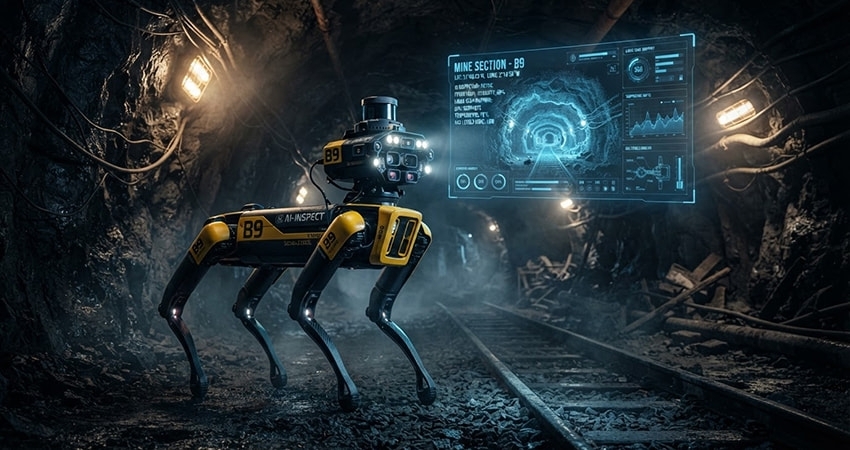
A robotic quadruped's real performance is defined not only by AI, but by the precision and durability of its drivetrain system.
As generative artificial intelligence matures rapidly, robotic quadrupeds have captured global attention across industrial exhibitions and commercial markets. While AI serves as the cognitive "brain," the physical stability, dynamic balance, and operational reliability of a robotic quadruped fundamentally depend on its hardware architecture—specifically, its joint transmission system. This technical brief examines the core operational principles, deployment landscapes, and critical hardware evaluation metrics for modern robotic quadrupeds.
A robotic quadruped is an advanced mobile robot engineered to emulate canine locomotion. Through multi-degree-of-freedom (DoF) joint configurations, these systems traverse complex, unstructured environments including stairs, slopes, and rubble-strewn terrains. The core framework relies on three tightly integrated systems:
Quadruped robots span a wide spectrum from consumer-grade entertainment units to heavy-duty industrial systems. Understanding powertrain requirements across distinct classifications is vital for engineering deployment:
〈Read more: Choosing Motor Basics: Types of AC Motors & DC Motors〉
System integrators frequently prioritize algorithmic AI performance while underestimating mechanical transmission integrity. Gearbox precision and motor torque directly govern motion stability and spatial positioning accuracy. Inadequate transmission components induce mechanical vibration, positioning drift, and premature wear.
This comparison highlights how drivetrain configuration directly impacts robotic quadruped performance across applications.
〈Read more: What Are Planetary Gearboxes?〉
〈Read more: What Is a Servo Motor? A Complete Guide to Principles, Structure, Types, and Applications〉
Mechanical failure in a robotic quadruped joint module triggers costly downtime and safety risks. Given the intricate multi-axis integration of quadruped limbs, replacement expenses are substantial. Procurement engineers must evaluate:
As applications expand, companies must evaluate not only AI capabilities but also the mechanical core. High-quality planetary gearboxes and motors are essential for building scalable and reliable robotic systems.
〈Read more: What Are Speed Reducers? How Do They Work?〉
As generative artificial intelligence matures rapidly, robotic quadrupeds have captured global attention across industrial exhibitions and commercial markets. While AI serves as the cognitive "brain," the physical stability, dynamic balance, and operational reliability of a robotic quadruped fundamentally depend on its hardware architecture—specifically, its joint transmission system. This technical brief examines the core operational principles, deployment landscapes, and critical hardware evaluation metrics for modern robotic quadrupeds.
Defining the Robotic Quadruped: Architecture and Mechanics
Robotic dogs rely on synchronized sensing, control, and actuation to achieve stable locomotion across complex terrains.A robotic quadruped is an advanced mobile robot engineered to emulate canine locomotion. Through multi-degree-of-freedom (DoF) joint configurations, these systems traverse complex, unstructured environments including stairs, slopes, and rubble-strewn terrains. The core framework relies on three tightly integrated systems:
- Perception System: High-resolution LiDAR and depth-sensing machine vision for environmental mapping.
- AI Control Algorithms: Real-time kinematic solvers and motion planning networks.
- Powertrain & Transmission: High-torque motors coupled with precision gearboxes.
Types of Robotic Quadrupeds: Consumer vs. Professional Industrial Grade
Different application scenarios impose fundamentally different requirements on drivetrain precision and durability.Quadruped robots span a wide spectrum from consumer-grade entertainment units to heavy-duty industrial systems. Understanding powertrain requirements across distinct classifications is vital for engineering deployment:
Consumer & Educational Units
Prioritizing interactive engagement and cost efficiency, these platforms utilize low-power direct-current (DC) motors paired with lightweight plastic gear trains, suited exclusively for flat indoor environments.〈Read more: Choosing Motor Basics: Types of AC Motors & DC Motors〉
Professional Industrial Inspection Units
Deployed in automated factories, chemical refineries, and power substations, these systems require autonomous navigation, obstacle avoidance, and continuous high-load operation. Precision backlash management and high-torque density are mandatory.Search, Rescue & Hazardous Operations
Operating in extreme environments such as disaster zones, mines, or rugged outdoor fields, these systems demand elite dynamic balance, impact resilience, and military-grade reliability to prevent mission-critical failures.The Mechanical Heart: Why Precision Transmission Dictates Performance
Drivetrain quality directly impacts motion stability, positioning accuracy, and system lifespan.System integrators frequently prioritize algorithmic AI performance while underestimating mechanical transmission integrity. Gearbox precision and motor torque directly govern motion stability and spatial positioning accuracy. Inadequate transmission components induce mechanical vibration, positioning drift, and premature wear.
High-Precision Planetary Reducers
Offering exceptional torque density and near-zero backlash, planetary reducers enhance joint control accuracy, yielding instantaneous response times and fluid motion trajectories. Multi-gear load-sharing distributes stress evenly, suppressing vibration across dynamic and static states.High-Torque Actuators & Reducers
Sustained output under continuous high-load profiles allows robotic quadrupeds to execute high-dynamic maneuvers—such as bounding and leaping—without thermal degradation.| Application | Core Power Requirement | Gear Type | Motion Precision | Durability & Environment |
| Toy / Educational | Standard DC Motor | Plastic Gear Train | Low (basic locomotion only) | Standard (indoor, flat surfaces) |
| Home Companion | Compact Servo Motor / Brushless Motor | Precision Gearbox | Medium (basic posture control) | Medium (impact-resistant design required) |
| Industrial Inspection | High-Torque Servo Motor | High-Precision Planetary Gearbox | Very High (accurate terrain navigation & obstacle avoidance) | High (continuous heavy-duty operation) |
| Search & Rescue | High-Power Brushless Motor | Reinforced Planetary Gearbox | Very High (dynamic balance & anti-fall capability) | Military-grade (extreme environment resistance) |
〈Read more: What Are Planetary Gearboxes?〉
〈Read more: What Is a Servo Motor? A Complete Guide to Principles, Structure, Types, and Applications〉
Procurement Evaluation: Prioritizing Lifecycle Durability and MTBF
Hardware reliability is more critical than software features for long-term deployment success.Mechanical failure in a robotic quadruped joint module triggers costly downtime and safety risks. Given the intricate multi-axis integration of quadruped limbs, replacement expenses are substantial. Procurement engineers must evaluate:
- Mean Time Between Failures (MTBF) of the transmission assembly.
- Torsional Backlash Stability and wear resistance over extended lifecycles.
- Supplier Technical Support, custom engineering responsiveness, and lead-time reliability.
Sesame Motor: The Premier Powerhouse for Robotic Motion
With over 35 years of engineering expertise in motion technology, Sesame Motor specializes in high-precision planetary reducers and gear motors. Engineered for low backlash, superior efficiency, and extended operational lifespans, Sesame Motor’s transmission solutions empower global automation and robotics leaders to achieve peak reliability.Conclusion
For robotic quadrupeds, drivetrain precision and durability are the true foundation of performance and reliability.As applications expand, companies must evaluate not only AI capabilities but also the mechanical core. High-quality planetary gearboxes and motors are essential for building scalable and reliable robotic systems.
〈Read more: What Are Speed Reducers? How Do They Work?〉