
What Is a Motor Controller? Types, Benefits, and Industrial Applications
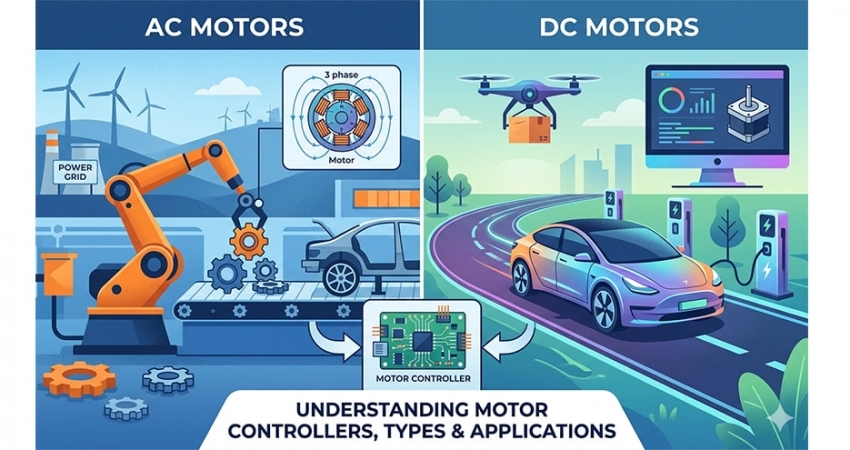
In today's rapidly evolving world of industrial automation and smart manufacturing, precise motion control is one of the defining factors that separates high-performance systems from conventional machinery. At the heart of every efficient motion control system is the motor controller. From robotic arms on automated assembly lines to the propulsion systems of electric vehicles (EVs), motor controllers play a critical role in ensuring smooth, accurate, and reliable motor operation. Acting as the "conductor" behind every movement, they coordinate motor performance to maximize productivity, efficiency, and operational safety. This guide explores what motor controllers are, how they work, the different types available, their industrial applications, and the key factors to consider when selecting the right motor controller for your automation system.
〈Read more: Machine Optimization Through Small Reduction Motors〉
〈Read more: How Does an Induction Motor Work? Types and Uses〉
〈Read more: What Are Speed Reducers? How Do They Work?〉
By adjusting the frequency and voltage of the incoming power supply, VFDs precisely regulate motor speed and torque while improving energy efficiency. They are widely used in applications that require continuous operation and high power output, including industrial fans, pumps, compressors, conveyors, and other heavy-duty production equipment. In addition to reducing energy consumption, AC motor controllers also minimize mechanical stress during startup and shutdown, helping extend equipment lifespan and lower maintenance costs.
〈Read more: Motor Power, The Key to Choosing the Right Motor!〉
〈Read more: What Is a Servo Motor? A Complete Guide to Principles, Structure, Types, and Applications〉
〈Read more: Choosing Motor Basics: Types of AC Motors & DC Motors〉
〈Read more: What is the Importance of Lubrication in Planetary Gearboxes?〉
〈Read more: What Are Planetary Gearboxes?〉
〈Read more: Planetary Gearboxes: Types and Pick Up the One Fits You〉
〈Read more: How to Select the Right Planetary Gearbox for Your Motor: Tips for Optimal Performance〉
Looking for the right motor controller, motor, or gear reducer for your application? Contact SESAME MOTOR today to receive expert technical consultation and customized motion control solutions tailored to your operational needs.
〈Read more: Machine Optimization Through Small Reduction Motors〉
What Is a Motor Controller? The Intelligent Core of Modern Motion Control
A motor controller is an electronic device that regulates the operation of an electric motor by managing the electrical power delivered from the power source. If the motor serves as the "muscle" of a machine, the controller functions as its "brain," translating control commands into precise motor movement. Motor controllers receive input signals from various sources—including manual controls, programmable logic controllers (PLCs), industrial PCs, or automated software—and convert those signals into carefully controlled electrical output. Using technologies such as Pulse Width Modulation (PWM), the controller precisely manages motor speed, torque, acceleration, direction, and stopping performance. Rather than simply powering a motor on or off, a motor controller enables intelligent motion control that improves positioning accuracy, operational consistency, and overall system efficiency. This level of precision is essential for today's automated manufacturing equipment, robotics, CNC machinery, and other high-performance industrial applications.〈Read more: How Does an Induction Motor Work? Types and Uses〉
Why Are Motor Controllers Important? Three Key Benefits
A motor controller is far more than a power management device—it is a critical component that enhances performance, protects equipment, and enables intelligent automation. By delivering precise control over motor operation, it helps manufacturers improve productivity while reducing operating costs.1. Improved Efficiency and Optimized System Performance
Precise control of motor speed, direction, and torque is fundamental to maximizing production efficiency. A high-quality motor controller supplies only the amount of power required for each operating condition, minimizing unnecessary energy consumption while maintaining optimal motor performance. This intelligent power management reduces mechanical stress, minimizes vibration, and optimizes system output. As a result, equipment experiences less wear and tear, motor lifespan is extended, and production lines operate more reliably with fewer interruptions.2. Enhanced Equipment Protection and Lower Maintenance Costs
Modern motor controllers incorporate multiple built-in protection functions designed to safeguard both the motor and the overall system. Common protection features include:- Overvoltage protection
- Overcurrent protection
- Overtemperature monitoring
- Short-circuit protection
- Stall and overload protection
3. Intelligent Automation and Precision Motion Control
As Industry 4.0 and smart manufacturing continue to evolve, motor controllers have become key components of connected automation systems. Modern controllers integrate seamlessly with Programmable Logic Controllers (PLCs), Human-Machine Interfaces (HMIs), industrial sensors, and motion control software to execute highly accurate and dynamic operations. Many advanced motor controllers also support remote monitoring, real-time diagnostics, and performance data collection, enabling operators to optimize system parameters from centralized control platforms. This connectivity transforms traditional motors into intelligent assets within a fully integrated industrial automation ecosystem.〈Read more: What Are Speed Reducers? How Do They Work?〉
Types of Motor Controllers: Understanding the Most Common Solutions
Not all motor controllers are designed for the same purpose. Different applications require different levels of precision, power output, and control capability. Motor controllers are typically classified according to the type of motor they drive and the performance requirements of the application. Below are the four most common types of motor controllers used in industrial automation and motion control systems.AC Motor Controllers
AC motor controllers—commonly known as Variable Frequency Drives (VFDs) in industrial applications—are the preferred solution for controlling AC induction motors in large-scale manufacturing environments.By adjusting the frequency and voltage of the incoming power supply, VFDs precisely regulate motor speed and torque while improving energy efficiency. They are widely used in applications that require continuous operation and high power output, including industrial fans, pumps, compressors, conveyors, and other heavy-duty production equipment. In addition to reducing energy consumption, AC motor controllers also minimize mechanical stress during startup and shutdown, helping extend equipment lifespan and lower maintenance costs.
〈Read more: Motor Power, The Key to Choosing the Right Motor!〉
DC Motor Controllers
DC motor controllers provide fast response times and a relatively simple control architecture, making them ideal for applications requiring frequent speed changes and rapid directional control. By regulating the input voltage supplied to the motor, these controllers deliver smooth and accurate speed control for both brushed and brushless DC (BLDC) motors. Common applications include electric vehicles (EVs), automated doors, mobile robots, AGVs, medical devices, and compact industrial machinery where quick acceleration and deceleration are essential.Servo Motor Controllers
Servo motor controllers are engineered for applications requiring exceptional positioning accuracy and dynamic motion control. Unlike open-loop systems, servo controllers operate using a closed-loop feedback system, continuously monitoring encoder signals to detect and correct position, speed, and torque errors in real time. This continuous feedback enables highly accurate, repeatable movement even under changing load conditions. Servo motor controllers are widely used in robotic arms, CNC machine tools, semiconductor manufacturing, automated inspection systems, packaging machinery, and other precision automation equipment where micron-level accuracy is critical.〈Read more: What Is a Servo Motor? A Complete Guide to Principles, Structure, Types, and Applications〉
Stepper Motor Controllers
Stepper motor controllers operate by sending a sequence of electrical pulses to the motor. Each pulse rotates the motor shaft by a fixed step angle, allowing precise incremental positioning without requiring continuous position feedback in many applications. Because of their inherent open-loop control capability, stepper motor systems offer an excellent balance between precision, simplicity, and cost-effectiveness. They are commonly found in 3D printers, desktop CNC machines, laboratory instruments, textile equipment, and other automation systems that require accurate positioning at moderate speeds.〈Read more: Choosing Motor Basics: Types of AC Motors & DC Motors〉
Motor Controller Applications: Powering Modern Industries and Everyday Life
Motor controllers are essential components across a wide range of industries. From large-scale industrial automation to consumer products, they enable reliable, efficient, and intelligent motion control that keeps modern systems operating smoothly.Industrial Automation and Production Lines
In automated manufacturing facilities, motor controllers coordinate the movement of conveyors, robotic arms, packaging equipment, and material handling systems. By synchronizing multiple motors with high precision, they help maximize production throughput while maintaining consistent product quality. Their ability to deliver stable performance around the clock makes them indispensable for high-volume manufacturing environments.Precision Manufacturing Equipment
High-precision machinery depends on accurate motor control to achieve consistent results. Equipment such as CNC machining centers, laser cutting machines, semiconductor manufacturing systems, and high-speed printing presses rely on motor controllers to precisely regulate speed, torque, and positioning. This level of control ensures dimensional accuracy, superior surface finish, and repeatable manufacturing quality.Electric Vehicles and Transportation Systems
Motor controllers serve as the core of every electric drivetrain, directly influencing vehicle performance, energy efficiency, and driving experience. They manage acceleration, deceleration, torque delivery, and regenerative braking, optimizing power distribution between the battery and electric motor. Advanced motor control algorithms recover braking energy and convert it back into electrical power, extending driving range while improving overall vehicle efficiency and safety.Renewable Energy and Smart Building Systems
The growing adoption of renewable energy technologies has further increased the importance of advanced motor control. In wind turbines, motor controllers adjust blade pitch angles to maximize power generation while protecting equipment from changing wind conditions. Solar tracking systems use precision motor control to continuously align photovoltaic panels with the sun, increasing energy output throughout the day. Within smart buildings, motor controllers drive automated blinds, ventilation systems, HVAC equipment, and other energy-efficient building technologies. By optimizing motor performance, these systems reduce overall energy consumption, improve occupant comfort, and support long-term sustainability goals.〈Read more: What is the Importance of Lubrication in Planetary Gearboxes?〉
How to Choose the Right Motor Controller: 5 Key Factors to Consider
Selecting the right motor controller is essential for ensuring reliable operation, maximizing system performance, and protecting your equipment from costly failures. Since every application has unique power, control, and environmental requirements, it's important to evaluate several key factors before making a decision.1. Match the Voltage and Current Ratings
The first step in selecting a motor controller is ensuring that its electrical specifications match those of your motor and power supply. Verify both the rated operating voltage and the maximum output current supported by the controller. An undersized controller may overheat or shut down under heavy loads, while an oversized controller can increase system costs without providing additional benefits. Proper electrical matching helps ensure stable operation, improves efficiency, and prevents premature component failure.2. Evaluate Communication Interfaces and System Compatibility
Modern motor controllers are more than standalone devices—they are integral components of today's connected automation systems. Choosing a controller that supports industry-standard communication protocols makes system integration significantly easier. Common industrial communication protocols include:- CANopen – A CAN bus-based protocol widely used in industrial motor drives, factory automation equipment, and automotive applications.
- Modbus RTU/TCP – A simple, highly compatible communication protocol commonly used for PLC connectivity and industrial control systems.
- EtherCAT – A high-speed Industrial Ethernet protocol designed for real-time communication in high-performance, multi-axis servo motion systems.
3. Prioritize Built-in Protection Features
A reliable motor controller should incorporate comprehensive protection mechanisms to safeguard both the motor and the control system. Key protection features include:- Overvoltage protection
- Overcurrent protection
- Overtemperature protection
- Short-circuit protection
- Overload and stall protection
- Fault detection and abnormal signal monitoring
4. Consider the Operating Environment and Cooling Requirements
Environmental conditions have a significant impact on the long-term reliability and performance of a motor controller. Because high-performance motor controllers generate heat during operation, adequate ventilation or an efficient heat dissipation system is essential. Depending on the application, you may also need to consider additional environmental factors such as:- Ambient temperature
- Humidity and condensation
- Dust and airborne contaminants
- Corrosive environments
- Mechanical vibration and shock
- Electromagnetic interference (EMI)
- Installation altitude
5. Choose a Trusted Brand with Strong Technical Support
Even the most advanced motor control systems may require technical assistance during installation, commissioning, or troubleshooting. Working with a reputable manufacturer that offers experienced engineering support, responsive customer service, and comprehensive after-sales assistance can significantly reduce downtime and improve long-term system reliability. A trusted supplier not only provides high-quality products but also helps optimize system performance throughout the entire equipment lifecycle.〈Read more: What Are Planetary Gearboxes?〉
〈Read more: Planetary Gearboxes: Types and Pick Up the One Fits You〉
Frequently Asked Questions (FAQ)
What Is the Difference Between a Motor Controller and a Variable Frequency Drive (VFD)?
Although both devices are used to control electric motors, the terms are not interchangeable. A motor controller is a broad category that refers to any electronic device designed to control a motor's operation, including starting, stopping, speed regulation, direction, torque, and positioning. Motor controllers can be used with AC motors, DC motors, servo motors, and stepper motors. A Variable Frequency Drive (VFD), on the other hand, is a specific type of motor controller designed for AC induction motors. It regulates motor speed by varying the frequency and voltage of the AC power supplied to the motor. In other words, every VFD is a motor controller, but not every motor controller is a VFD.What Are the Signs of a Failing Motor Controller?
Several warning signs may indicate that a motor controller is malfunctioning or nearing the end of its service life. Common symptoms include:- Unusual noise or excessive vibration during operation
- The motor fails to start after power is applied
- Overheating of the controller housing
- Unstable or inconsistent motor speed
- Unexpected shutdowns or intermittent operation
- Error codes displayed on the controller interface
Can One Motor Controller Drive Multiple Motors?
In most applications, a motor controller is designed to operate a single motor to ensure accurate control, feedback, and protection. However, certain industrial motor controllers can drive multiple motors in parallel, provided that the motors have identical specifications and that the combined current and power requirements remain within the controller's rated capacity. Before implementing a multi-motor configuration, always consult the manufacturer's specifications to ensure safe and reliable operation.〈Read more: How to Select the Right Planetary Gearbox for Your Motor: Tips for Optimal Performance〉
Complete Motion Control Solutions from SESAME MOTOR
Reliable motors and gear reducers are the foundation of every high-performance automation system. As a trusted manufacturer of motors, gear reducers, and power transmission solutions, SESAME MOTOR delivers products engineered for exceptional reliability, high performance, and compliance with international quality standards. Whether you're designing new automation equipment or upgrading an existing production line, our engineering team works closely with you to recommend the most suitable motion control solution for your specific application. Beyond supplying individual components, we provide fully integrated drive solutions that help manufacturers improve productivity, increase system reliability, and accelerate the transition toward smarter, more efficient manufacturing. Partner with SESAME MOTOR to build automation systems backed by proven engineering expertise, dependable products, and long-term technical support.Conclusion
Motor controllers are fundamental to modern industrial automation and smart manufacturing. By providing precise control over motor speed, torque, direction, and positioning, they improve system efficiency, reduce energy consumption, and enhance operational reliability. From automated production lines and precision manufacturing equipment to electric vehicles, renewable energy systems, and smart buildings, motor controllers play a vital role in enabling accurate, efficient, and intelligent motion control across countless industries. When selecting a motor controller, it's important to evaluate factors such as motor compatibility, electrical specifications, communication protocols, environmental conditions, and after-sales support to ensure optimal long-term performance. With industry-proven products, experienced engineering expertise, and comprehensive motion control solutions, SESAME MOTOR helps manufacturers build reliable, high-performance drive systems for the next generation of industrial automation.Looking for the right motor controller, motor, or gear reducer for your application? Contact SESAME MOTOR today to receive expert technical consultation and customized motion control solutions tailored to your operational needs.